AI & Dev Digest: Open-Weight Models, Agentic AI, and Acquisition Waves
Stay updated with the latest in AI: China's open-weight model strategy, the quiet research of top AI startups, the impact of agentic AI on scientific computing, and Nscale's strategic acquisition of Anyscale.
Welcome to your daily dose of AI and software development news! Today's headlines bring a mix of strategic shifts in the AI landscape, groundbreaking applications of agentic AI in science, and significant industry consolidation. We'll explore why leading AI startups are keeping their research under wraps, how China is disrupting the market with open-weight models, and how AI agents are revolutionizing scientific computing.
TL;DR
- AI's top startups are barely publishing their research: Leading AI startups are increasingly withholding research publications to protect competitive advantages as AI transitions from science to industry.
- Nscale buys Anyscale as it seeks to own more of the AI ...: British AI neocloud Nscale has acquired Anyscale for an estimated $1.65 billion to expand its AI compute stack ownership.
- Scientific computing in the age of agentic AI: OpenAI reports on how AI coding agents, including Codex and Claude Code, are significantly accelerating scientific software development and maintenance, particularly in the life sciences.
- Scientific computing in the age of agentic AI: an exploratory field report: A detailed field report by researchers from OpenAI, UNC Chapel Hill, and others, highlights the promise and challenges of using LLM-based agents to address technical debt in scientific computing.
- Why China is giving away its best AI models: Chinese labs like Moonshot AI are releasing powerful open-weight AI models like Kimi K3 for free, challenging the dominance of closed American systems by offering greater control and lower costs to developers.
AI's top startups are barely publishing their research
 In a significant shift, leading AI startups are increasingly choosing not to publish their research findings, a trend that marks the maturation of AI from a scientific field into a competitive industry. This move is primarily driven by the desire to safeguard proprietary advancements and maintain a competitive edge in a rapidly evolving market.
Experts suggest that once companies reach a certain scale, where they can attract top talent and receive widespread attention without academic publications, the incentive to share research diminishes. The main perceived benefit of publishing then becomes alerting competitors to successful strategies and discoveries. This mirrors historical trends in other fields, such as chemistry, where open publication declined once commercial value, like dyes, became substantial, moving innovative work into private company labs.
The main remaining effect of publishing is to tell your competitors which things worked. This is what happens to every field as it turns from a science into an industry.
While this trend benefits established companies by protecting their intellectual property, it creates challenges for independent researchers and smaller startups. For those without the resources to hire widely, publishing research remains a crucial avenue for networking and gaining the attention of experts, as illustrated by one YC applicant who leveraged independent research to connect with a UK professor working on similar AI concepts.
Nscale buys Anyscale as it seeks to own more of the AI compute stack
 Nscale, a British AI neocloud provider, has announced its acquisition of software startup Anyscale for an estimated $1.65 billion. This strategic move aims to expand Nscale's footprint in the AI compute stack, allowing it to capture a larger share of its customers' AI spending. Anyscale is known for helping companies efficiently scale their AI workloads across diverse data centers and servers.
Anyscale was founded by the creators of the open-source Project Ray distributed programming Python framework. Initially, the company developed a platform for running projects requiring substantial computing power. Following the launch of GPT-3 in 2022, Anyscale pivoted to specialize in scaling services for various AI tasks, including large language model training and serving, data curation, inferencing, and reinforcement learning. Its platform integrates developer tools, observability, and orchestration built around the Ray framework.
In a bid to capture more of its customers’ AI spending, British AI neocloud Nscale is buying software startup Anyscale, which helps companies scale their AI workloads across data centers and servers.
The acquisition positions Nscale to offer a more comprehensive suite of services, from foundational infrastructure to advanced AI workload management. This integration is expected to provide Nscale customers with enhanced capabilities and streamline their AI development and deployment processes.
Scientific computing in the age of agentic AI
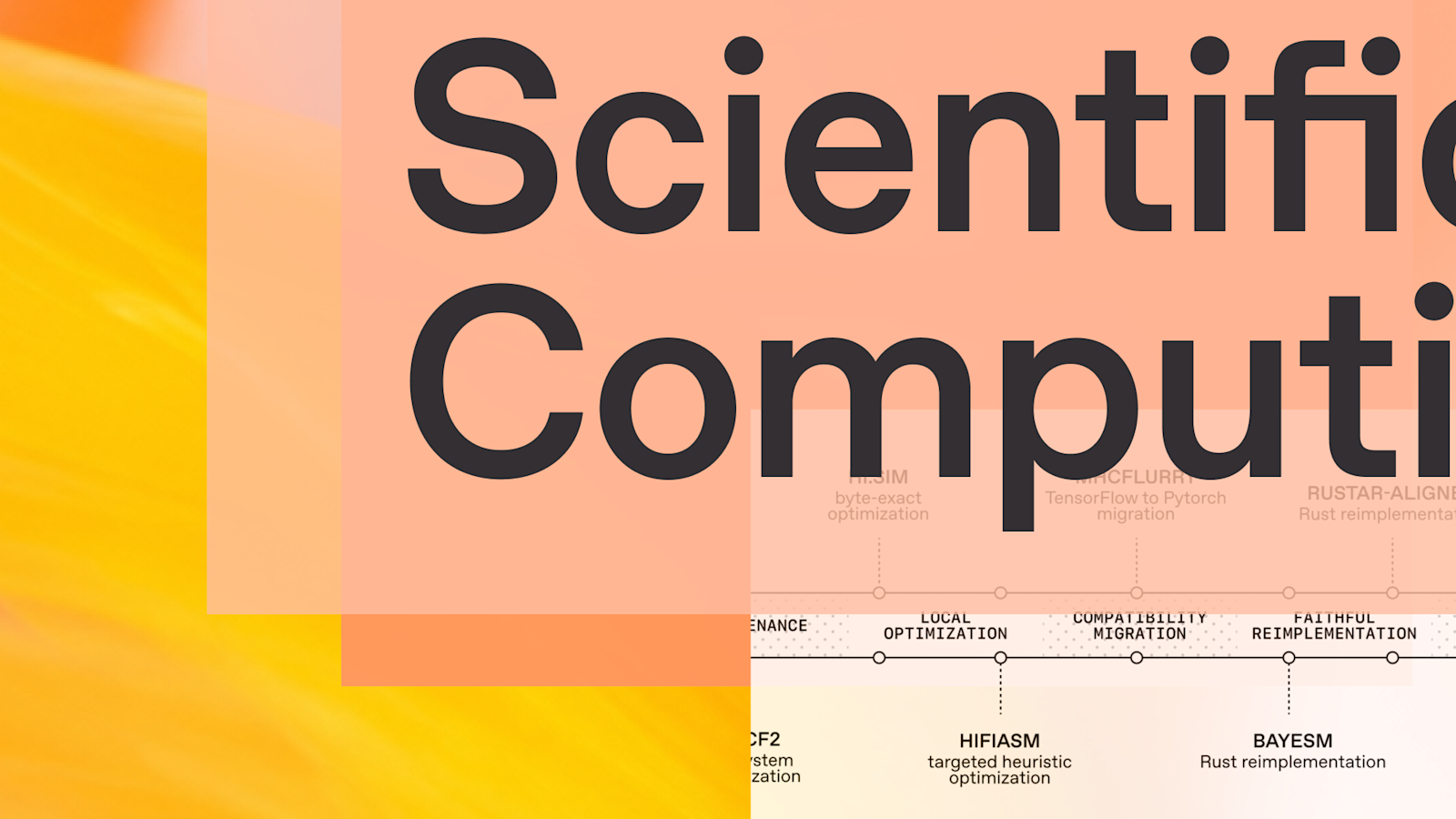 OpenAI has released a field report detailing how AI agents are transforming scientific computing, particularly in data-rich fields like genomics. Traditionally, scientific software, often developed by small academic teams with limited engineering resources, struggles with maintenance and optimization, hindering the pace of discovery. AI agents are now addressing these challenges by automating tedious implementation tasks and significantly lowering engineering costs.
The report highlights eight agent-assisted scientific computing projects, primarily within the life sciences. Five of these projects utilized Codex alone, while three employed a combination of Codex and Claude Code. These projects span various scopes, from routine maintenance and targeted optimizations to major language migrations and GPU-native redesigns. Contributors consistently reported that agents dramatically accelerated software development and maintenance, enabling small teams to undertake work that would otherwise require extensive time or specialized engineering support.
Agents significantly accelerated software development and maintenance, in some cases helping small teams take on work that would otherwise have required far more time or specialized engineering support.
This emerging model shifts the researcher's role from implementation to verification and orchestration. Scientists maintain control over scientific direction and quality, but with a significant boost in velocity provided by agentic assistance. For instance, GPT-5.5 was used to modernize cyvcf2, a Python library for genomic variant files, by replacing its legacy build system with a modern, unified process, simplifying installation and testing.
Scientific computing in the age of agentic AI: an exploratory field report
This detailed exploratory field report delves into the application of LLM-based agents in scientific computing, highlighting their potential to overcome persistent weaknesses stemming from technical debt and a shortage of specialized engineering expertise. The report, authored by researchers from institutions including OpenAI, the University of North Carolina at Chapel Hill, and the Allen Institute for Artificial Intelligence, focuses on eight early case studies primarily in the life sciences.
Scientific computing is a critical component of modern research, yet many computational tools, especially in the life sciences, face issues with performance and maintainability. These tools are often developed rapidly by small, specialized teams, leading to technical debt that impacts reliability and cost, particularly with the advent of high-throughput sequencing and molecular profiling that generate massive datasets.
Overall, we find that the use of coding agents in scientific computing holds great promise for accelerating scientific research and increasing the reliability of critical systems...
The case studies, which range from lightweight maintenance tasks to full performance-oriented rewrites of scientific libraries, demonstrate the significant promise of coding agents for accelerating scientific research and enhancing the reliability of critical systems. However, the report also acknowledges outstanding concerns, such as establishing clear responsibility and ownership for projects developed with agent assistance. The authors suggest collaboration and stewardship with existing maintainers whenever feasible to ensure long-term success and sustainability.
Why China is giving away its best AI models
 Chinese AI labs, spearheaded by companies like Moonshot AI, are making waves in the global AI landscape by releasing powerful open-weight models such as Kimi K3 for free. This strategy challenges the dominance of closed American models from industry giants like OpenAI, Google, and Anthropic, forcing them to reconsider their proprietary approaches.
Moonshot AI's Kimi K3 model has garnered significant attention for its alleged ability to outperform some top US systems at a fraction of the cost. The decision to release the model's weights for free, coupled with a clear targeting of US users, has intensified the rivalry between the US and China in AI. Open-weight models offer developers unparalleled control, allowing them to inspect an AI's internal workings, run it locally, customize it, and build new products independently of a single provider. This often results in significantly lower operational costs.
Open-weight models give developers far greater control than proprietary systems, allowing them to inspect how the AI functions, run the AI locally on their own infrastructure, customize the systems, and build new products without depending on a single provider.
This move by Chinese firms raises a critical question: why invest heavily in training an AI model only to give away its most valuable components? The strategy aims to democratize access to advanced AI, fostering a broader ecosystem of innovation and potentially establishing a de facto standard, much like Google's Android did for mobile operating systems. This disruption could fundamentally alter the competitive dynamics and adoption rates of AI technologies worldwide.