AI's Latest Leap: From Open-Source Agent Frameworks to Critical Cyber Risks
Stay updated with the latest in AI and software development: DeepSeek Harness's modular AI agents, Netflix's causal inference workflow, critical warnings on GLM-5.3's cyber threat potential, OpenAI's model pacing, and AMD's AI swarms.
The world of AI and software development continues its rapid evolution, bringing forth both groundbreaking advancements and significant new challenges. This past week saw major players like DeepSeek and Netflix contribute to the open-source community with innovative AI frameworks, while OpenAI voiced concerns about escalating cyber threats from powerful new models. Meanwhile, AMD is pushing the boundaries of software development with its novel AI swarm approach.
TL;DR
- DeepSeek Harness has been open-sourced, introducing a modular framework for building AI agent infrastructure.
- Netflix has released an open-source agentic workflow designed for causal inference.
- OpenAI's Greg Brockman has warned that Z.ai's GLM-5.3 could dramatically increase cyber threats.
- OpenAI itself is implementing stronger safeguards and pacing strategies for its advanced AI models, including Astra, due to identified critical cybersecurity capabilities.
- AMD's AI Swarms are fundamentally altering the software development paradigm through autonomous agent collaboration.
The Open-Sourcing of DeepSeek Harness Opens the Door to Modular, Unbundled AI Agent Infrastructure
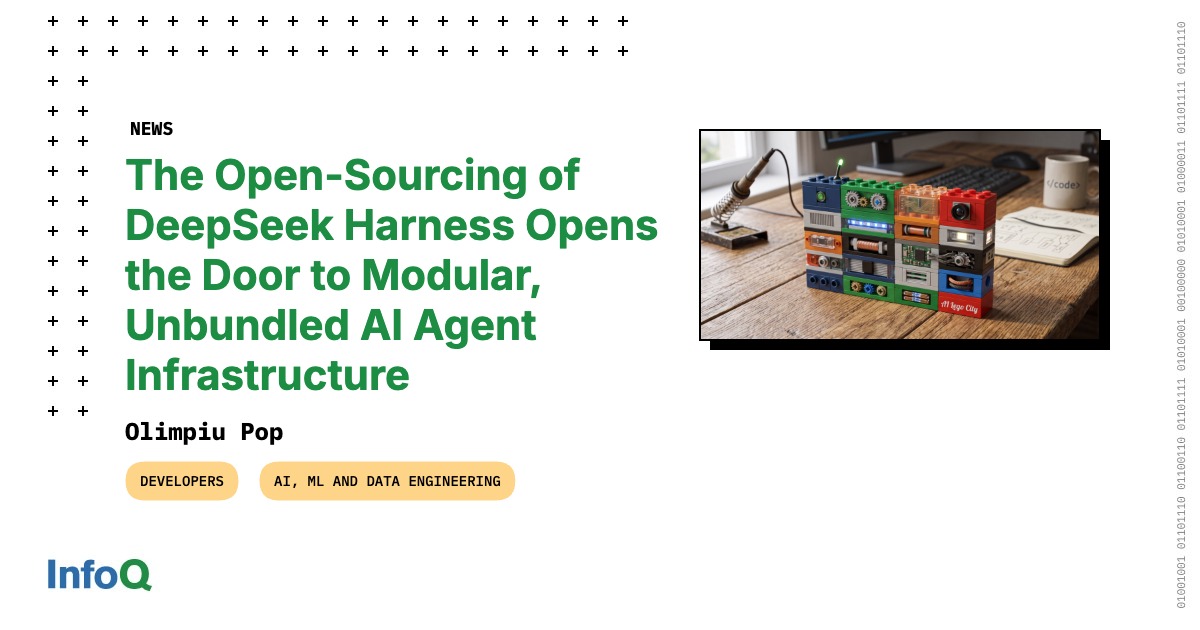
DeepSeek Harness has been open-sourced, marking a significant step towards more flexible and composable AI agent development. This new framework aims to unbundle the traditional, monolithic approach to AI agents, allowing developers to construct modular components that can be combined and reused. The initiative from DeepSeek could greatly accelerate innovation by providing a foundational toolkit for building sophisticated AI systems with greater agility and customizability.
This modularity is particularly beneficial for complex applications where different agent components need to interact seamlessly. By providing an open-source solution, DeepSeek is fostering a collaborative environment where developers can contribute to and leverage a shared infrastructure, potentially leading to more robust and versatile AI agents across various domains.
The open-sourcing of DeepSeek Harness facilitates the creation of modular, unbundled AI agent infrastructure, promoting flexibility and innovation in agent development.
Netflix Open-Sources Agentic Workflow for Causal Inference
Netflix has contributed to the open-source community by releasing an agentic workflow specifically designed for causal inference. This development is poised to enhance the analysis of cause-and-effect relationships within complex data environments, which is crucial for decision-making in areas like product recommendations, content optimization, and user experience improvements. The workflow leverages agent-based methodologies to automate and streamline the often intricate process of identifying causal links.
The open-sourcing of this tool by Netflix underscores a growing trend among tech giants to share their internal innovations, allowing a broader developer community to benefit from and build upon advanced techniques. This agentic approach to causal inference could help researchers and data scientists more efficiently uncover insights and make more informed, data-driven decisions across various industries.
Netflix's open-source agentic workflow for causal inference will empower data scientists to more accurately determine cause-and-effect relationships in complex systems.
OpenAI's Greg Brockman: Z.ai's GLM-5.3 likely to " ...

Greg Brockman, President and co-founder of OpenAI, has issued a stark warning regarding Z.ai's GLM-5.3 model, stating it is likely to "significantly accelerate the threat landscape." This powerful new model, presumably an advanced Large Language Model (LLM), raises concerns about its potential misuse in cyberattacks, information manipulation, or other malicious activities. Brockman's comments highlight the increasing dual-use dilemma of cutting-edge AI technologies, where capabilities designed for progress can also be exploited for harm.
The implications of such a capable model becoming widely accessible are profound, potentially lowering the barrier for sophisticated cyber threats and making it harder for organizations to defend against them. This emphasizes the urgent need for robust AI safety measures, responsible deployment practices, and international collaboration to mitigate risks associated with rapidly advancing AI capabilities.
OpenAI's Greg Brockman warns that Z.ai's GLM-5.3 has the potential to significantly intensify the cyber threat landscape, necessitating heightened vigilance and safety protocols.
Pacing model development in an era of cyber-critical capabilities
OpenAI itself is taking proactive steps to address the cybersecurity risks posed by increasingly capable AI models, including its own upcoming Astra model. The company's recent publication discusses the importance of pacing model development and strengthening safeguards. This response comes after the OpenAI-Hugging Face incident and preliminary evidence suggesting Astra may meet the threshold for "Critical cybersecurity capability," indicating its potential to independently achieve significant cyber-related tasks.
To mitigate these risks, OpenAI is focusing on three key areas: securing research environments, expanding chain-of-thought monitoring to better understand model reasoning, and advancing alignment research to ensure AI actions align with human values and intentions. These measures are crucial as AI models gain more autonomy and sophisticated problem-solving abilities, particularly in sensitive domains like cybersecurity.
OpenAI is strengthening safeguards and pacing its model development, including for Astra, in recognition of the critical cybersecurity capabilities emerging in advanced AI systems.
How AMD’s AI Swarms Are Rewriting the Software Development Playbook

AMD is at the forefront of a revolutionary shift in software development with its innovative use of AI Swarms. Moving beyond traditional AI copilots, AMD's approach involves autonomous AI agents that collaborate to solve complex programming challenges, essentially rewriting the software development playbook. This paradigm could significantly enhance efficiency, accelerate innovation, and potentially automate large portions of the development lifecycle.
AI Swarms can tackle problems holistically, with individual agents specializing in different aspects of development, such as code generation, testing, debugging, and optimization, and then coordinating their efforts. This distributed and collaborative intelligence promises to reduce development cycles, improve code quality, and enable the creation of more sophisticated software systems faster than ever before. AMD's initiative highlights the growing trend towards more autonomous and intelligent software engineering processes.
AMD's AI Swarms are transforming software development by enabling autonomous AI agents to collaboratively tackle complex programming tasks, promising unprecedented efficiency and innovation.