AI & Tech Daily Digest: Gemini Goes Free, Data Center Innovations, and Global AI Workforce Shifts
Stay updated with the latest in AI and tech: Google's Gemini offers free personalized image generation, Omen AI tackles data center efficiency, OpenAI maps Europe's AI job landscape, China's Z.ai challenges cybersecurity leaders, and Tesla's FSD faces heightened scrutiny. Your daily dose of innovation and industry insights.
Welcome to your daily dive into the rapidly evolving world of AI and software development! Today, we're seeing major advancements in AI accessibility, crucial innovations for underlying infrastructure, and significant geopolitical shifts in AI capabilities and workforce planning. From consumer-facing tools becoming free to critical enterprise solutions and national security implications, the pace of change continues to accelerate.
TL;DR
- Google's Gemini is now offering its personalized Nano Banana-powered image generation feature for free to all eligible U.S. users, democratizing advanced AI creative tools.
- Omen AI is tackling the costly bacterial contamination issue in liquid-cooled data centers with a real-time spectrometer solution, aiming to prevent millions in downtime.
- OpenAI Economic Research has released a new report, "The AI Jobs Transition Framework for the EU," mapping potential AI impacts on Europe's diverse labor market.
- China's Zhipu AI (Z.ai) has introduced its open-weight GLM-5.2 model, claiming it can match Mythos in specific bug-finding and cybersecurity scenarios, raising national security concerns.
- Tesla's Full Self-Driving (Supervised) system is under increased scrutiny following a fatal crash in Texas, highlighting ongoing safety concerns in autonomous driving technology.
Gemini’s personalized AI image generation is now free for US users

Google has made a significant move in democratizing AI tools by announcing that Gemini's personalized Nano Banana-powered image generation feature is now available for free to all eligible users in the U.S. This service was previously exclusive to Gemini Plus, Pro, and Ultra subscribers, marking a broader expansion of advanced generative AI capabilities.
The feature, initially introduced in April, allows users to create images tailored to their specific needs and preferences. This shift to a free model for a wider audience underscores Google's strategy to make its cutting-edge AI more accessible, potentially accelerating adoption and integration of generative AI into everyday creative workflows for millions of users.
Google's decision to offer personalized AI image generation via Gemini for free to U.S. users significantly broadens access to advanced generative AI technology, moving it from a subscription-only feature to a widely available tool.
Omen AI’s plan to optimize data centers is all wet

The escalating demand for compute power, largely driven by AI, is pushing data centers to optimize every aspect of their operations, including cooling systems. This intensified need has inadvertently led to an increase in bacterial outbreaks within liquid-cooled chips. Data center managers often adjust the fluid mix to run chips hotter, incorporating more water for better heat absorption, but this also creates conditions ripe for bacterial growth that can clog systems.
Such contamination necessitates system flushes, which can mean shutting down a rack for five or six hours, potentially costing millions of dollars in lost operational time. Omen AI has developed an innovative solution: a tiny spectrometer capable of monitoring fluid health in real time. This device can detect bacterial growth before it becomes a critical issue, thus preventing costly shutdowns and enhancing efficiency.
Omen AI's real-time spectrometer technology addresses the critical problem of bacterial contamination in liquid-cooled data centers, potentially saving millions in downtime by preventing severe issues before they arise.
Mapping Europe’s AI Workforce Opportunity
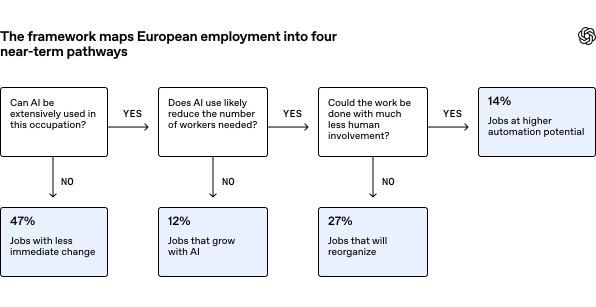
OpenAI Economic Research has released a new comprehensive report, "The AI Jobs Transition Framework for the EU," extending its previous U.S.-focused analysis to the European labor market. This report addresses critical questions regarding AI's labor market impact, where these impacts will be most felt, and strategies to ensure an equitable AI transition.
The framework leverages the official European Skills, Competences, Qualifications and Occupations (ESCO) taxonomy and Eurostat employment data to examine near-term occupational changes across EU member states. Notably, the report suggests that the EU has a smaller share of employment in occupations with higher near-term automation potential compared to the U.S. It categorizes occupations into four archetypes: those that may grow with AI, those at higher automation potential, those likely to reorganize, and those with less immediate change, serving as a planning map for future adjustments and opportunities.
OpenAI's new report provides a crucial "planning map" for the EU, indicating that Europe's labor market structure may face less immediate automation pressure from AI compared to the U.S. due to its unique mix of occupations and institutions.
China’s Z.ai claims it can match Mythos on cybersecurity

China's Zhipu AI (Z.ai) has made headlines with the release of its open-weight GLM-5.2 model, with some researchers asserting its capability to match Anthropic's Mythos in specific bug-finding and cybersecurity scenarios. While GLM-5.2 still lags behind models from Anthropic and OpenAI in broader general tasks, this development signifies a dramatic reduction in the capabilities gap between Chinese and U.S. AI models, particularly in specialized areas.
This advancement is a source of considerable concern for the U.S. government, which has actively sought to restrict China's access to powerful AI models like Mythos and Fable, as well as the essential hardware required for their training and operation. The Trump administration views advanced AI models capable of identifying vulnerabilities as significant national security threats. The open-weight nature of GLM-5.2 further exacerbates these concerns, as it can be freely downloaded and run on readily available hardware, making it highly flexible but also potentially susceptible to misuse by malicious actors with minimal oversight.
The release of Zhipu AI's GLM-5.2 highlights a narrowing gap in AI capabilities between China and the U.S., particularly in cybersecurity applications, raising significant national security implications due to its open-weight accessibility.
TechCrunch Mobility: All eyes on Tesla FSD

Tesla's automated driving system, Full Self-Driving (Supervised), is currently facing increased scrutiny, largely due to a series of recent incidents. A fatal crash in Texas, where a Tesla struck a home and resulted in the death of a 76-year-old woman, has garnered significant national attention. The driver informed police that Autopilot, Tesla's basic driver-assistance system, was engaged at the time of the accident.
This incident is part of a broader trend of heightened examination of Tesla's FSD and Autopilot systems, underscoring ongoing concerns about their safety and reliability on public roads. As AI continues to integrate into transportation, the performance and accountability of such advanced driver-assistance systems remain a critical topic for regulators and the public alike.
The fatal Tesla crash involving Autopilot in Texas intensifies the public and regulatory scrutiny on Tesla's Full Self-Driving (Supervised) system, highlighting persistent safety concerns around advanced driver-assistance technologies.