AI & Dev Daily Digest: Anthropic's Design Rival and OpenAI's Codex Super App Push
Catch up on the latest AI innovations: Anthropic challenges Figma with Claude Design, while OpenAI's Codex gets major updates enabling background computer use, an in-app browser, and a glimpse into its 'super app' future. Plus, Codex gains memory features and robust plugin support.
The AI and software development landscape continues its rapid evolution today, with major players pushing the boundaries of what intelligent agents can do. From creative design tools vying for market share to powerful coding assistants gaining unprecedented control over your desktop, the future of work is being redefined, one update at a time.
TL;DR
- Anthropic launched Claude Design, a new AI-powered design platform aiming to compete with Figma and Canva.
- OpenAI's Codex desktop app now features the ability to perform tasks on your PC in the background without interrupting your work.
- OpenAI's Codex Desktop has expanded beyond a coding tool to a broader productivity powerhouse, now capable of running your computer and featuring an in-app browser.
- The latest Codex update from OpenAI is laying crucial groundwork for its anticipated "super app," integrating various AI capabilities into one cohesive experience.
- OpenAI's Codex received a significant update, enabling macOS app control, image generation, new plugins, and a memory feature, directly challenging Anthropic's Claude Code.
Anthropic Launches Claude Design to Rival Figma and Canva
 Anthropic has made a significant foray into the creative design space with the introduction of Claude Design. This new platform is built upon its powerful Claude AI model and is positioned as a direct competitor to established design tools like Figma and Canva. The launch signals Anthropic's ambition to extend its AI capabilities into more user-facing applications beyond core language processing.
While specific features of Claude Design were not detailed in the provided content, its branding implies an AI-driven approach to graphic design and user interface creation. This move could empower users with AI-assisted design generation, rapid prototyping, and automated layout suggestions, potentially streamlining workflows for designers and non-designers alike. The competition with market leaders like Figma and Canva will undoubtedly drive further innovation in the AI design tools sector.
Anthropic's Claude Design aims to revolutionize the design workflow, leveraging AI to challenge industry giants.
OpenAI's Codex Gains Background PC Control and In-App Browser
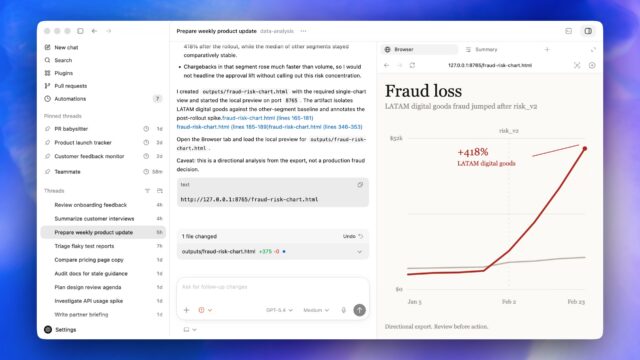 OpenAI has rolled out a substantial update to its Codex desktop app, introducing a suite of new features that significantly enhance its capabilities. Most notably, Codex can now perform tasks on your PC in the background. OpenAI states that this functionality allows the AI to use all applications on a computer by seeing, clicking, and typing with its own cursor, all without interfering with a user's ongoing work on the desktop. This means multiple agents can operate in parallel on a Mac, proving beneficial for developers iterating on frontend changes, testing apps, or working with applications lacking an API.
Beyond background operation, Codex also gains the ability to schedule work, waking itself up hours, days, or even weeks in advance to perform predefined tasks. An integrated in-app web browser is another key addition, allowing users to visually assess Codex's web-related work and provide feedback directly on specific parts of a page, akin to existing web design collaboration tools. The update further incorporates gpt-image-1.5 for image generation, enabling the creation of mockups and other visual assets within the application.
OpenAI's Codex can now seamlessly interact with and control desktop applications in the background, marking a significant step towards autonomous computing.
Codex Desktop Evolves into a Productivity Powerhouse with Computer Control and Automation Memory
 OpenAI's Codex Desktop app has received a "significant update," transforming it from primarily a coding tool into a more comprehensive productivity solution. While still targeted at programmers, the new features, including "computer use," allow the AI within Codex Desktop to operate a user's computer. This means Codex can run applications in the background, enabling users to continue with other tasks simultaneously. OpenAI highlighted that 80% of its staff utilize Codex, suggesting its broader utility beyond just coding.
Key takeaways from ZDNET's report emphasize that Codex Desktop is expanding into full productivity workflows, with automation capable of generating images, charts, and various workflow outputs. The introduction of an in-app browser with a commenting system further enhances its utility for web development and design feedback. This update positions Codex as a tool that can not only generate code but also automate complex tasks across a user's entire digital environment, bridging the gap between an AI assistant and an operating system.
The latest Codex Desktop update elevates it beyond a mere coding assistant, granting it the power to operate a user's computer and streamline comprehensive productivity workflows.
OpenAI's Latest Codex Update Lays Groundwork for "Super App" Vision
 OpenAI has released a major update to its Codex application, signaling the initial stages of its ambitious "super app" project. While the full super app, which aims to combine ChatGPT, the Codex coding agent, and the Atlas web browser, isn't launching today, this update offers developers a preview of OpenAI's future direction. Thibault Sottiaux, head of Codex, stated that OpenAI is "building the super app out in the open," with a clear intention to broaden its audience beyond developers in the future.
The updated Codex introduces multi-purpose AI agents capable of interacting with other applications on a PC, allowing users to either specify a program or let the AI select the most suitable tool. OpenAI highlights its proprietary "secret sauce" that enables agents to run apps in the background without impacting system performance, facilitating collaborative work between user and AI. Additionally, the release includes 111 new plugins that integrate skills, app connections, and model context, expanding Codex's ability to gather information and utilize developer tools. A built-in browser with a commenting system and integrated gpt-image-1.5 image generation further solidify its comprehensive capabilities.
OpenAI's Codex update is a strategic move, showcasing the foundational elements of its upcoming "super app" designed to provide developers with highly proactive and versatile AI agents.
OpenAI’s Codex Update Takes Direct Aim at Anthropic’s Claude Code
 OpenAI has significantly upgraded its agentic coding and development system, Codex, with a suite of features designed to intensify its competition with rivals, particularly Anthropic’s Claude Code. The update enables Codex to operate desktop applications on macOS, including working in the background without interrupting user activities. This functionality is described as highly beneficial for developers, aiding in testing and iterating on frontend changes, app testing, and interacting with applications that lack an API. The rollout for macOS users signed in with ChatGPT begins today, with EU users and other operating systems to follow.
Furthermore, Codex now supports image generation and iteration using gpt-image-1.5, and includes new plugins for popular developer tools such as GitLab, Atlassian Rovo, and Microsoft Suite. An in-app browser allows users to provide direct instructions to the agent through comments on web pages. The update also introduces enhanced automation capabilities, allowing users to reuse conversation threads and enabling Codex to schedule and automatically perform future tasks. A preview of an opt-in memory feature will allow Codex to recall personal preferences, corrections, and previously gathered information, aiming to expedite future tasks and improve output quality without extensive custom instructions.
OpenAI's Codex is making a bold move against Anthropic’s Claude Code by introducing extensive desktop control, advanced image generation, broad plugin support, and critical memory features to streamline developer workflows.